Software: Hypertexte mit dem HTML Editor KompoZer erstellen

Der Editor in WordPress, aber auch  viele andere rich-text-Editoren, stellen nicht immer alle die Möglichkeiten zur Verfügung, die für die Erstellung eines gut formatierten Textes benötigt werden.

In dem WordPress – Editor fehlen zum Beispiel die Formatierungsmöglichkeiten, Zahlen hochzustellen, um Flächen- oder Volumenangaben in der Standardform zu formatieren.

Auch das Einfügen von Tabellen fehlt.

Da der WordPresseditor neben der normalen Textansicht auch den HTML Code anzeigen kann ( oben  rechts im Editorfenster steht neben Visual  HTML ), ist es möglich, in den im  HTML Code angezeigten Text,  weiteren HTML Code einzufügen oder den vorhandenen zu ändern.

Es ist aber recht mühsam, längere Texte manuell mit HTML Code zu schreiben. Deshalb sind HTML Editoren sehr hilfreich.

Der HTML Editor KompoZer ist ein kostenloser, open source WYSIWYG –  Editor, der mehr Möglichkeiten als der WordPress-Editor bietet.

Vorgehensweise:

  • der gewünschte Text wird in dem Editor geschrieben, der html – Code kopiert und an der gewünschten Stelle in den html-Code des WordPress-Editors eingefügt.
  • umschalten auf Visual und prüfen, ob das gewünschte Ergebnis erreicht wurde, falls nicht,  Text im KompoZer Editor korrigieren.

Einige wichtige Merkmale:

  • sehr gutes Manual
  • die Größe von Tabellen und Zellen in ihnen können angepasst werden
  • es können parallel Dokumente in mehreren Windows bearbeitet werden
  • es können Hintergrundfarben verwendet werden
  • mit dem Editor kann auch der html-Code von Webseiten oder eBooks bearbeitet werden.
Veröffentlicht unter Schreiben, Softwarebesprechung | Verschlagwortet mit , | Hinterlasse einen Kommentar

Information networks: applied to multidemensional cubes part 7

In the following posts we will explain, how to appy the findings about networks, to analyze the structure of multidimensional cubes.

We investigate the multidimensional cubes in orthogonal, Euklidean spaces, that means:

  • the coordinate axes are orthogonal
  • in Euklidean spaces of any dimension, the theorem of Pythagoras is valid

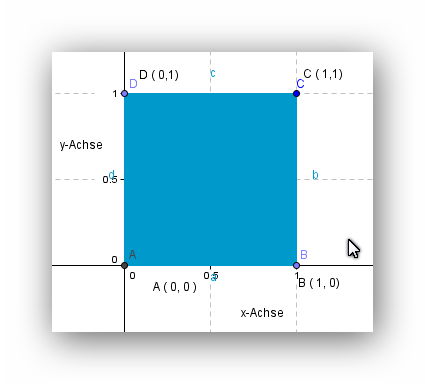
We start with a square in the  2-dim  Euclidean space and then go on to higher dimensions.
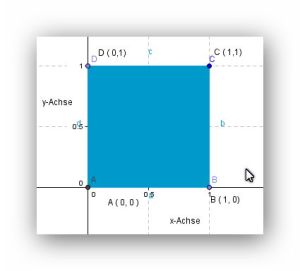
Einheitsfläche

We use following conventions:

  • the horizontal coordinate-axis is labelled as the x-axis
  • the vertical coordinate – axis is labelled the y-axis
  • both axis are orthogonal
  • the length of each side, is 1  m

From that it follows:

  1. dimension of Euclidean space = 2
  2. area of square = 1 m^2
  3. main diagonal  is AC   =  1.414  = BC

Now we imagine, that we are living in a two-dimensional world and that therefore we have no idea, how a cube in 3 dimensions will look like.

How can we find it out, by using only mathematical reasoning ?

At first we see, that we have to use 2 coordinate axes in 2 Dimensions and therefore  a 3. coordianate axis is needed, if we make calculations in 3-dimensional space.

Because  in 2 dimensional space we label each point with 2 figures, like P (  x,y ), we now have to label a point in 3 dimension as P ( x,y,z )

Because we cannot draw and construct a 3 dimensional cube, because we are living in a two-dimensional world, we can use only algebraic methods, because we also cannot visualize a cube in 3 dimensional space.

  • We know, that the x, y and z axis must be orthogonal, because  now, we have a 3 dimensional Euclidean space.
  • in 2  dimensions, we have a square with 4 corners. But how many corners will a 3 dimensional cube  have ? Because we cannot visualize a 3 dimensional cube, we don’t know it.

Therefore we have to check in detail, how we labelled the corner points of the square.

(0,0), (0,1), (1,0), (1,1)

Apparently, each coordinate of a point can have only the values 0 or 1 and all possible combinations of them  are used. Therefore we get 4 corner points.

We can go on one step further now, because the use of   o and 1 reminds us of the binary number system, like:

21 20 decimal number labels of
points
0 0 0
=  A
0 1 1
=   B
1 0 2
=   D
1 1 3
=   C

Now we can apply an elegant method, how to use number-labels for the corner points in a consistent way, which we can use also for multi dimensional cubes.

We transfer the binary numbers into decimal numbers

00  →  0

01   → 1

10  → 2

11   → 3

And we can use now these number labels, which will be much better for all calculations in multidimensional cubes:

A   → 0,      B   → 2,     C  → 3,       D   →1

To get a bit familiar with this kind of labelling, we calculate the distances  L   between these points.

L01 = 1     L02 = 1   L03=1.414    L12 = 1.414   L13 = 1  L23 = 1

We get the lengths of  the 4 edges and the 2 diagonals.

The main diagonal goes from point 0 to point  3

L03 and L12 are calculated, using the Theorem of Pyhthagoras in othogonal triangles.

Now we repeat all steps, but for a cube in 3 dimensional space.

  • because we have one additional  coordinate axis, we have to use 3 positions for the  binary numbers, to define each corner
  • each binary number we transfer again into a decimal number
22 21 20 number labels of
points
0 0 0 0
0 0 1 1
0 1 0 2
0 1 1 3
1 0 0 4
1 0 1 5
1 1 0 6
1 1 1 7

We remark following features:

  • if the 3. coordinate is 0, then we get the projection of the 3 dimensional cube onto the 2 dimensional plane. That means, that the points 0, 1, 2,3  are the corner points of the square
  • if the 3. coordinate is 1, then 4 new corners show up.
  • in total we get 8 corners, which is  just  2^3

We could now calculate again all distances between these points  and would find:

  • All edges have the length 1 m
  • all diagonals in square faces have the length 1.414 m
  • but we also get 4  new diagonals, which have the length 1.73 m

When we check, how we calculate these diagonals, we see, that the 3. dimension is included  in the Theorem of Pythagoras and that the lengths of these space diagonals is just the square root of the dimension of the cube.

Now we could calculate the lengths  of all paths, whichever we like.

As an example we only calculate the length  the path 01234567

L 07 = 1+1.414+1+1.73+1+1.414+1 = 8,56 m

  • Does there exist shorter paths, which use another sequence  of points, to come from point  0 to point 7, but which include  also each point only once ?

To summarize, what we found out :

  • each corner point  of  a  cube in  an  n-dimensional Euclidean space, is defined by a binary number with n positions
  • each corner can be labelled by using the decimal number, which is tranferred from the binary number representation of the corner coordinates
  • the lengths of the edges are always 1 m and are  independent from the dimension of the space.
    • The same is valid for the areas of the faces of the cube; each is 1 m^2
  • The volume is also always 1, but the unit for the volume is dependent on the dimension, like
    • area of square = 1 m^2
    • volume of 3 dimensional cube =  1 m^3
    • volume of 4 dimensional cube  = 1 m^4
    • volume  of n-dimensional cube = 1 m^n
  • the lengths of the diagonals are also dependent on the dimension of the space

To understand better the structure of such cubes, we must find answers to several questions, like for instance:

  • How many square faces do multidimensional cubes have ?

We know, that in 2 dimensions there is just 1 square face and in 3 dimensions there are 6 square faces. But these informations are not yet enough, to find any pattern, which correlates the number of square faces with the dimensions  of the cubes.

Because we cannot visualize cubes of higher dimensions than 3, we have to use again an algebraic approach.

We ask ourselves following:

  • what characterizes a square face ?

Answer:

  • each square face has 4 corners
  • the distance beween neighbour corners is 1
  • the diagonals have the lengths 1.414

But that does not yet help us, to answer the question, because there is still one problem:

  • how do we know, that 4 corners are neighbour corners and are in the same plane ?

Definition:  a plane in a multidimensional Euclidean space is defined by 3 different points on it.

One straigthforware  method, to investigate, if all 4 corner points are on the same plane is, to calculate the equation for the plane, which is defined by  3  corner points and then check, if also the 4. corner points is on this plane.

Because that needs quite some calculations, I  postpone it a bit, hoping, that my  brain works a bit during sleep and finds a clever solution for it, which could save us a lot of work.

At least I have the feeling, that there must exist a much simpler method.

Veröffentlicht unter information networks | Verschlagwortet mit , , | Hinterlasse einen Kommentar

Information networks: how to construct paths in incomplete networks part 6

Just some remarks about incomplete networks, which are very important, because in most applications we will face them.

Up to now we have focused on:

  • complete networks
  • complete networks without feedback loops
  • and have shortly mentioned also directed complete networks, which have no feedback loops and  in which each path runs only in the same direction, starting with the lower point number and ending at a higher point number

In applications we will face any kind of incomplete networks, in which some connections between points do not exist.

The general procedure to deal with any kind of   incomplete network is:

  • we start with a complete network of the same order as the incomplete network has
    • we calculate all paths in the complete network
    • we filter out all the paths, which fulfill all conditions of the incomplete network
  • we compare the incomplete with the complete network and calculate several key figures, with which we can characterize incomplete networks and compare them one with the other, but also with the complete network of the same order.

For incomplete  networks of low order we can do it manually, but in general we will need to use computer programs.

The general procedure,  to write a program is:

  • we calculate all subsets for the set with n points
  • we calculate all permutations for each of the subsets
  • we apply several    if-then-else  conditions, which specify, which paths we want to keep.

The details, how to do it, depend of course on the programming language.

  • in Lisp and similar languages ( like also Wolfram ) , we have to deal with lists and then apply the commands for lists, to filter out the wanted paths.
  • in Fortran and  similar languages, we have to use matrices, in which each row represents a path. We then check each row with the  if -then- else conditions, which we integrate in  do- loops.

For networks of very high order, probably to use Fortran might be better. If we want to analyze  information network structures in biology for instance, in which eventually billions of points define the network, then Fortran probably is the best choice, because for it very advanced compilers exist, which can do the calculations parallel on many computers.

We will discuss applications in future posts, using both languages.

But before we leave the ideal world of abstract information networks, we want to consider as a geometric application  multidimensional cubes  🙂

Veröffentlicht unter information networks | Verschlagwortet mit , , , | Hinterlasse einen Kommentar

Information networks: how to construct paths part 5

Here we show, how paths from order 3 to order n  can be constructed in complete networks.

We use the Software program Mathematica for it.

We consider the numbers of the points in the network to be a mathematical set.

  • if the network has n points, then the set is  M= { 1,2,3, …  n }
  • each set has 2^n  sub sets, including the set itself and the void set.
  •  The set M  with 4 points M = {1,2,3,4} has then 16 subsets in total, but we are interested only in subsets, which have 3 or more elements, up to n elements, because a path needs to have minimal 3 points or more.

Step 1: 

In Mathematica we can use the function:

KSubsets[ {1,2,3,4},3]  and we get the 4 subsets:

  • {1,2,3}, {1,2,4},{1,3,4},{2,3,4}
  • and we have to add the set itself, because each set is a subset of itself

Because a set has only different elements, feedback loops are excluded automatically by this approach.

 Step 2:

In the second step we must calculate  for each subset all permutations, for which we use the function Permutations in Mathematica:

Permutations [1,2,3]

Permutations[1,2,4]

Permutations[1,3,4]

Permutations[2,3,4]

Permutations[1,2,3,4]

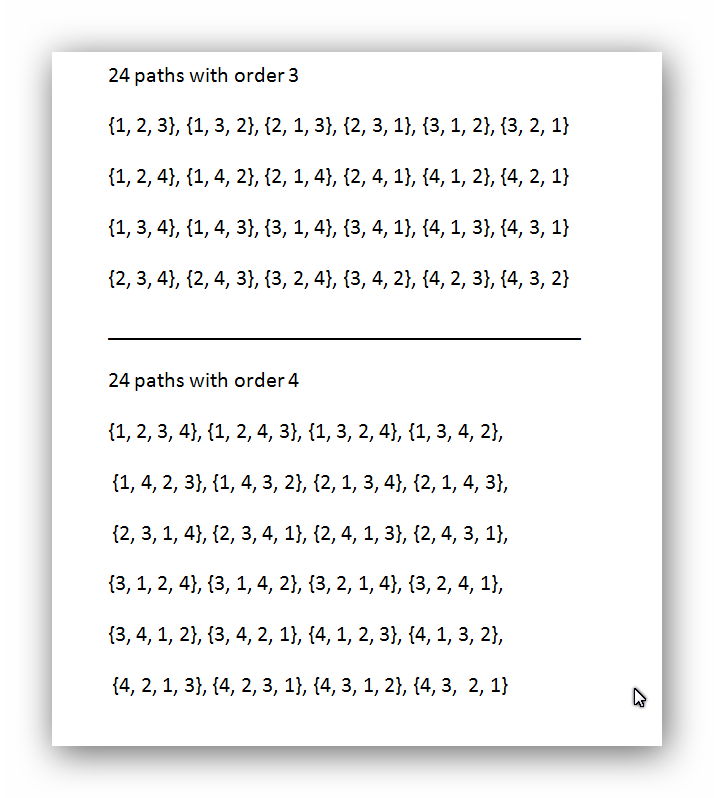
PathsOrder3Oder4

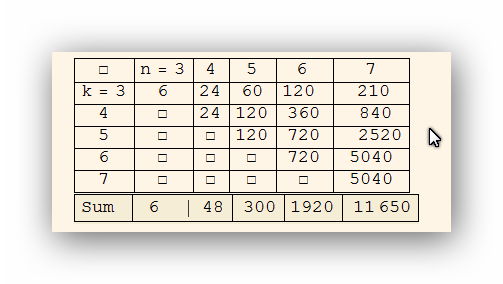
We check, if these results agree with our  earlier  calculations,  in the table below:

PathsOrder7

and see, that a complete network of order n=4   has 24 paths of order 3 and 24 paths of order 4

With the help of Mathematica it is no problem, to calculate the paths of almost any order. The limit is only the RAM of the used Computer.

Networks of order higher than about 7 and especially all the paths in them, can only be analyzed with the help of Computer-Softwareprograms.

But we must check of course, if the calculations are correct, using networks of lower order, which we still can analyze with manual calculations

Veröffentlicht unter information networks | Verschlagwortet mit , , , | Hinterlasse einen Kommentar

Information networks: paths in multidimensional cubes part 4

The following shall demonstrate, how powerful the concept of information networks is.

We apply this concept, to calculate the paths in multidimensional cubes.

People, who have not studied mathematics or physics, in general have no idea, what a space with 4 dimensions or even many more dimensions could be and how it is possible, that one can tell anything about them.

One astonishing fact we can tell directly:

  • After having studied information networks already in some detail, we know, that we can calculate, how many different paths of any order  exist in any multidimensional cube.

How is that possible, if we not yet have any idea, how such a multidimensional cube looks like ?

Simple !  We just ignore the dimensions.  They are irrelevant, if we are interested only  in the number of  paths.

  • The only number, which we have to know is, how many corners a multidimensional cube has and that we will calculate in some of the coming posts. And that is enough, to calculate  the number of  all paths from order 3 up to order n, which is the dimension  of the cube.
    • Thereafter we apply, what we have found out about paths in information networks.
  • if we also want, to construct the paths, then we have to do some more work.
    • we must find a clever way, how to label all corners of a cube, which is easy for a 3-dim cube, but not intuitively clear, how to do it with multidimensional cubes, because we cannot visualize them. And that is, because during the evolution of our brain, men never lived  in multidimensional spaces and therefore no brainstructures do deal with them, has been developed.

But we can overcome that problem, by using mathematical reasoning. Of course, even with that, we cannot visualize multidimensional cubes. It is similar to optical illusions; even if we know, that it is an illusion, we cannot avoid to get misled by it, because we have the wrong structure in  the system of our senses, nerves and in the brain.

Example:

A  cube in 3 dimensions has 8 corners, which is easy for us to visualize.

We directly can answer, how many different paths are possible, which include each of these corners, that means, we ask, how many paths of order 8 exist:

number of paths =  8! / ( 8-8)! = 8!/1  =  8!  =  1*2*3*4*5*6*7*8  = 40 320

Of course, probably  nobody really would be able  to construct all these paths  manually, but it is no problem, to do it, using a  mathematical  software program like Mathematica and we will show it for paths of lower order, like for paths of order 3, for which there exist

8!/(8-3)! = 8!/5! = 6*7*8 = 386  different paths.

We will develop the concept of information networks step by step further  in the next blog posts and also use multidimensional cubes  to demonstrate that concept.

Veröffentlicht unter information networks | Verschlagwortet mit | Hinterlasse einen Kommentar

Information networks: number of different paths. part 3

The minimal path in an information network has 3 points ( and therefore the path has the order k=3 )

  • one starting point
  • one mid point
  • one target point

and we can specify each path by a  sequence of figures  like 123  or 231  etc.

An important question when  analyzing networks is, how many different paths exist in a complete network ( without feedback loops ) and all its sub-networks.

  • in a network of order 3 exist 6 different paths.

We consider only open paths; the number of closed paths is just twice the number of the open paths.

Two equations from mathematical combinatorics are used:

The faculty of a natural number n is  noted  as n! = 1*2*3* …n

Examples:

3! = 1*2*3 = 6

4! = 1*2*3*4 = 24

Important to note is the definition:   0!  = 1

If we want to calculate, in how many different ways we can form different groups  of k numbers,  if n different numbers are given, then we can calculate that with following equation:

Kombinatorik

This equation is valid, if it the order of the k chosen numbers does not matter.

If the order matters, we have to multiply this equation with k! , because there exist so many different arrangenents  of  k numbers.

Kombinatorik2

And then we get the number of different paths in a complete network of order n,  each path with k  different  points

 tabelle2

The complete network has the order 7.

  • In the first row are the orders of the sub-networks
  • In the first column are the orders of the paths, 3 being the minimal possible order.

From this table we can deduce probabilities, that a certain path will be used.

For instance, if we know, that the complete network has the order n = 5 and that there will be taken a path of order k= 3, then the probability for it is 1/60

For a network of order n=3 and a path of order k=3, the probability is 1/6. That is 10 times higher, than for a network of order n=5

From that observation we can deduce a criteria, to find out, if we really use a complete network of order n.

We have only to note, how many times a path of order k exists. If for instance, we find out, that  paths of order 3 exist 50 times, then the order of the complete network must be at least n= 5

If we have found only 4 points, then at least 1 point is still missing, to get the complete network. And in this way we can go on with the other orders of paths.

Veröffentlicht unter information networks | Verschlagwortet mit , , | Hinterlasse einen Kommentar

Information networks: graphical representations part 2

To investigate information networks,  it helps, to switch between graphical and algebraic representations of a network.

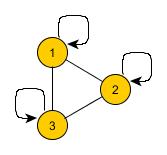
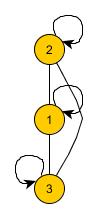
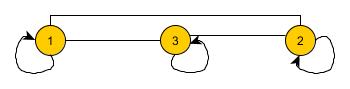
Here are given different graphical representations of a complete network of order 3.

Each representation may be better suited, to analyze a particular application. From a general abstract point of view, the informtion content is but the same.

Netzwerk Ordnung3circle

This is a representation, in which all points are arranged in a circle. For many abstract information networks this is a very good representation.

  • points are numbered in a counter clockwise manner, which is a quite common convention in mathematics, but which has no deeper meaning. Just  kind of standardization.
  • This network shows the feedback loops of all points and  all connections between them.

Just to train the brain, different other graphical representations are given of this same network. This training is important,  to remember, what kind of representations are possible, when a particular application is analyzed.

Netzwerk Ordnung3baumartig Netzwerk Ordnung3Hierarchie Netzwerk Ordnung3orthogonal Netzwerk Ordnung3radial Netzwerk Ordnung3usartig

With 3 points only, it is still not so difficulty, to understand the relations in a network, but with more than about 5 it can already get quite hard and then the algebraic representation gets more and more powerful. And therefore we have also to train  the algebraic representation, so that it is very easy for us, to draw conclusions from it.

Veröffentlicht unter information networks | Verschlagwortet mit | Hinterlasse einen Kommentar

Information networks: some mathematical basics. part 1

Information networks can be represented by points and connections between them. In general the points and their connections do not have any geometrical meaning. But of course, if an information network represents a travelling route  on a map for instance, then the points and their connections have also a geometrical meaning.

But at first we consider only abstract information networks and if we represent them with a drawing, then the drawing should not get geometrically interpreted.

At first we consider complete information networks.

Definition 1:  A   network, which has  n points and all connections between them, is called a  complete information network.

The number of points are called the order of the network.

Conclusions:

There exist  n*n=n^2 connections between n points, which is easy do demonstrate.

As an exmple we use only a network with 3 points:

  • the points are numbered  1, 2, 3
  • the connections are numbered, using 2 figures: the first is the starting point and the second the target point

__1   2    3
1  11 12  13
2  21 22 23
3  31 32 33

In the table the numbers of the points are in row 1 and in column 1.

The connections are in the other cells of the table.

  • 11, 22 and 33  are connections of  the 3 points with themselves, which we call feedback loops.
  • 12, 13, 23  are the reverse connections  of  21, 31 and 32

If we can exclude all feedback loops  and if the directions are not of interest, then there are:

m =  (n^2-n )/2= n ( n-1)/2

connections between n points;  in the example with 3 points, there are  3 connections.

Definiton 2:  A path consists of at least 3 points, which are connected, so that each point has one or 2 neighbour points. There are 2 points in a path, with only 1 neighour: the starting and the target point.

Convention:

If an information network has maximal 9 points, then we can use an abbreviation, to write paths:

Example:

  • 123  is the path, which starts at point 1 over point 2 to point 3
  • 35789 is the path, which starts at 3, goes over 5,7,8 to point 9

If there are more than 9 points in an information network, then we would run into trouble:

  • 12411 could mean 1-2-4-11   or  1-2-4-1-1  and with more than 9 points, we will therefore use this notation for paths.

Definition 3: A complete network without feedback loops and reverse connections is called a  one-direction complete network.

Now it starts, to get interesting:

  • We ask ourselves, how many paths exist in a complete networks and in one direction complete network  with 3, 4 etc.  up to 9 points

There are two methods, to answer this question:

  • we make sketches of all paths
  • we make algebraic calculations

For networks with 3 or even 4 points, sketches could be used. But with 5 or more points,we will find, that this is almost impossible, because there exist too many paths.

That is a typical problem, when objects can be combined in many different ways. The number of combinations increases dramatically, if the number of points increases.

Veröffentlicht unter information networks | Verschlagwortet mit , , | Hinterlasse einen Kommentar

Software: Writing mathematical equations with Math- Magic Editor

Math-Magic is  a  wysiwyg- editor, which is specialized, to write mathematical equations.

  • For personal use, a free  lite -version is available.
  • For commercial use the software, inclduing tax,  costs  78 euro.  ( Students get a  discount. )

Math-Type, another professional mathematical  editor-program costs 128 euro

In the wikipedia several mathematical editors are compared.

Math-Magic  has all features, which are needed, to edit mathematical equations for publication.

  • If Math-Magic is used  in Posts on a WordPress-Blog,  the equations, which are written with the Math-Magic – Editor, must at first be saved  on the harddisk in the  jpg-Format.
  • Then the file is uploaded into the Media-Library of the WordPress-Editor  and if one clicks on the corrsponding picture,  the file is incldued in the Blog-Post.

Example:

Test2

This equation is written in the Math-Magic Editor, saved on the hard disk, uploaded to the Media-Library and then included as  a  jpg-image here in the Blog-Post.

This image can be further adjusted, if one clicks onto it.  Then a menu opens and one can choose from several options.

At first it looks a bit complicated, but after  a short time it is done automatically.

The benefit is, that the mathematical equations look really great.

Microsoft Word and OpenOffice – Writer

If one writes texts in Microsoft Word, then equations can be copied from the Math-Magic Editor and  pasted directly  into Word. The eqations can be zoomed in and out, without losing  print quality.

If one uses  OpenOfficeWriter,  then this procedure does not work, because the print quality of the equations gets  very bad.

Veröffentlicht unter Schreiben, Softwarebesprechung | Verschlagwortet mit , | Hinterlasse einen Kommentar

Große Denker der Menschheit: Laotse, Dschuang Dsi und Konfuzius

Laotse lebte im 6. Jahrhundert v. Chr.,  Konfuzius um 500 v. Chr. und  Dschuang Dsi im 4.  Jahrhundert vor Chr. in China.

  • Laotse  erklärt in seinem Werk  Tao-Te – Ching die Grundlagen des Taoismus, der von der Annahme ausgeht, daß es ein alles durchdringendes geistiges Feld gibt.
  • Konfuzius lehrte Mitmenschlichkeit und Gerechtigkeit
  • Dschuang Dsi anerkennt die Lehren von Laotse und kommentiert sie durch logische Untersuchungen.

Wenn wir versuchen, die Schriften dieser 3 Weisheitslehrer zu verstehen,  gibt es mehrere Probleme:

  • wir müssen darauf vertrauen, daß die Übersetzungen die chinesischen Begriffe richtig übertragen
  • wir müssen verstehen, daß Laotse und Dschuang Dsi annehmen, daß es ein geistiges Feld gibt ( kein persönlicher Gott )  und dass Menschen es erfahren können, wenn sie ihr Denken in Begriffen und ihr ich-Gefühl überwinden.

Und das ist ein grundsätzlicher Unterschied zu allen abendländischen Philosophen, die immer in ihrem begrifflichen Denken beharren.

Epikur sagt:

Nichts entsteht aus Nichts

David Hume sagt

Wir können nicht nachweisen, dass es ein Kausalitätsgesetz gibt, wir können nur eine Reihenfolge von Ereignissen beobachten und können nicht sicher sein, dass sie in derselben Weise fortgesetzt wird

Kant zeigt, dass unser Denken in unlösbare Widersprüche gerät, wenn  unsere Begriffe zu allgemein und zu abstrakt werden.

Dieselbe Erkenntnis wird in der naiven mathematischen Mengenlehre von Cantor gefunden, die durch Bertrand Russell und Whitehead so axiomatisiert und eingeschränkt wird, dass diese Widersprüche nicht mehr auftreten. ( dafür müssen sie aber einige Erkenntnisse von Cantor opfern )

Diese grundlegenden Unterschiede  zwischen der chinesischen und der abendländischen Philosophie zeigen sich klar bei Dschuang Dsi  in seinem Werk

Das wahre Buch vom südlichen Blütenland

Kapitel:  Die ideelle Welt und die Wirklichkeit

Dschuang Dsi sagt, dass es im chinesichen Altertum die Maxime gab, dass es einen letzten Ausgangspunkt gibt und dass die Dinge sich daraus entwickelt haben:

1. Zeitraum :  Die Existenz der Dinge hat noch nicht begonnen

2. Zeitraum:  Es gibt Dinge, sie sind aber noch nicht getrennt.

3. Zeitraum: Es gibt Getrenntheiten aber es gibt noch keine Gegensätze.

Durch die Entfaltung der Bejahung und Verneinung verblaßt der Sinn und es entwickelt sich eine eindeutige Zuneigung, wodurch sich logische Spitzfindigkeiten entwickeln

Auch Dschuang Dsi findet heraus, dass  unser Denken sich in Widersprüche verwickeln kann  und dass es deshalb weggelassen werden muss, wenn man die Wirklichkeit erfahren will.

Im abendländischen Denken wird dieser letzte Ausgangspunkt immer als prima causa bezeichnet und mit Gott gleichgesetzt.

Der Taoismus identifiziert den letzten Ausgangpunkt nicht mit einem Gott.

Beiden Denkweisen gemeinsam ist aber, dass sie einen letzten Ausgangpunkt glauben annehmen zu müssen.

Sie können sich nicht vorstellen, dass es nie  das Nichts gegeben hat.

Soweit wir bisher das Weltall beobachten können, gibt es keinen Ort, in dem  nichts ist. Es gibt überall kosmische Elentarteilchen und Kraftfelder.

Also können wir nur schließen dass sich alles, was existiert,  sich fortlaufend umwandelt, aber nie in Nichts umgewandelt wird.

Unsere Denkstruktur ist anscheinend  beschränkt, so dass wir immer automatisch in die Denkfalle  geraten, annehmen zu müssen, dass es einen ersten Anfang gegeben haben muss.

Dafür gibt es aber keinerlei naturwissenschaftlichen Notwendigkeiten.

Nehmen wir an, dass es immer  Etwas gab, das sich umwandeln kann, gibt es keinen Widerspruch zum Kausalitätsgesetz.

In der Mathematik haben wir keine Denkprobleme, wenn wir uns die reelle Zahlengerade als im   Minus- Unendichen beginnend, bis zum Positiv-Unendlichen reichend vorstellen.

Kein Mathematiker hat heute noch ein Problem damit.

Wir können also sagen:

Alles Existierende  entsteht durch Umwandlung aus Existierendem.

Veröffentlicht unter Große Denker der Menschheit | Verschlagwortet mit , , | 1 Kommentar